
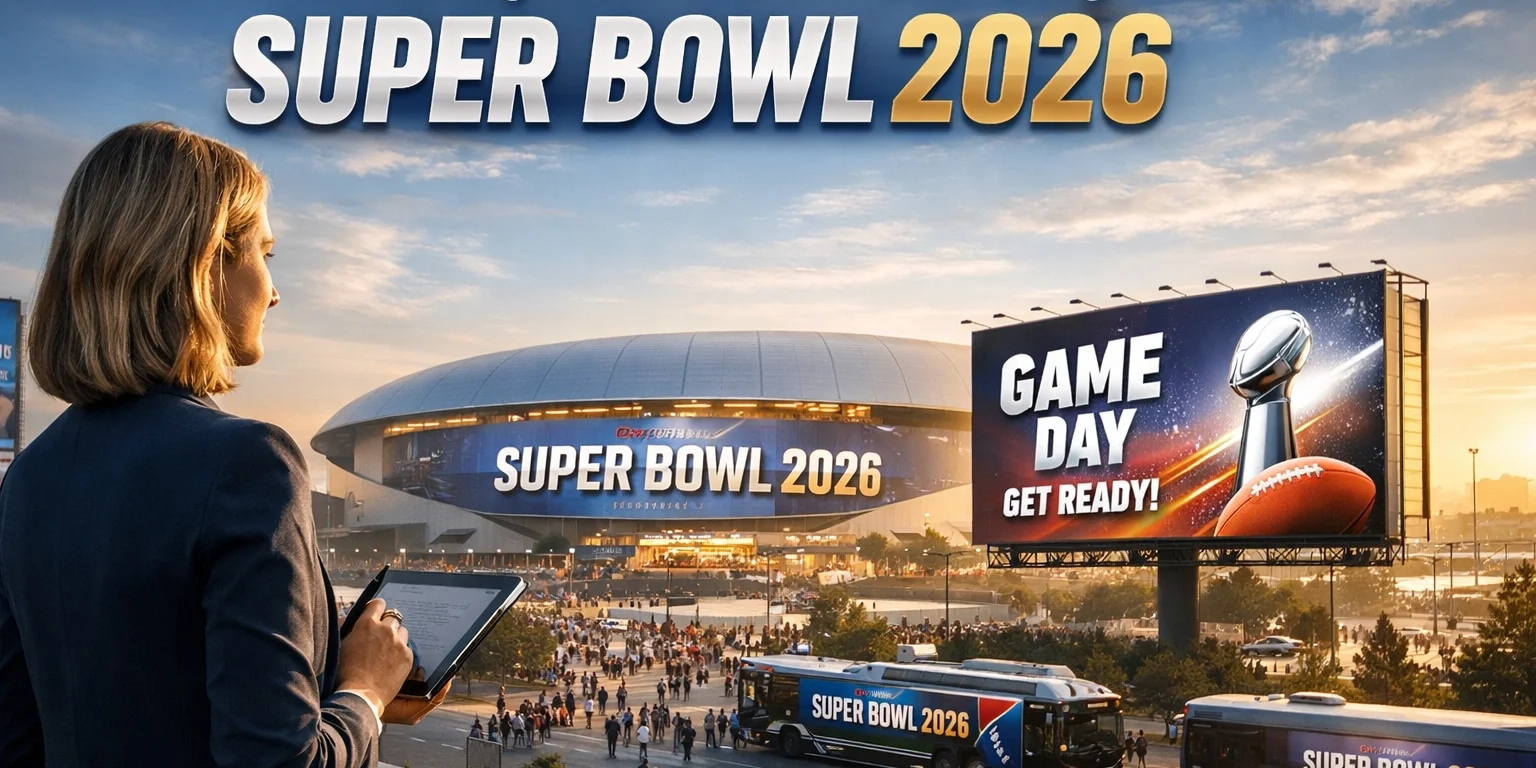
The Super Bowl isn't just a game anymore; it’s a full-blown cultural takeover. For brand managers, the 2026 installment represents the ultimate high-stakes arena. But here’s the reality: if you’re only thinking about a 30-second TV spot, you’re missing the biggest piece of the puzzle. While millions watch from home, hundreds of thousands of high-value consumers are descending upon the host city, ready to spend, engage, and share their experiences.
At USA Entertainment Ventures LLC, we’ve seen the landscape shift. The real wins in 2026 won’t just happen on the field or in the commercial breaks: they’ll happen in the streets, the airports, and the concourses. This is the era of Out-of-Home (OOH) environmental domination. If you want your brand to be the one fans remember when they fly home, you need a strategy that owns the environment from the moment they land until the final whistle blows.
Why OOH is the New MVP
Let’s talk numbers. Traditional TV spots are iconic, but they are also fleeting. You get 30 seconds of attention: maybe: if the viewer isn't checking their phone or grabbing a wing from the buffet. In contrast, venue and citywide OOH advertising offers a captive audience for hours.
Research shows that fans spend an average of four hours inside the stadium on game day. During that time, they are navigating concourses, waiting for food, and soaking in the atmosphere. Unlike a TV ad, they can't skip, mute, or fast-forward through a 40-foot LED display or a high-impact floor graphic. The result? Brands utilizing comprehensive stadium coverage see a staggering 144% increase in purchase intent among exposed audiences.

The Sporttron Digital Network Advantage
To truly dominate, you need more than just a few billboards. You need a network that integrates your message into the very fabric of the fan experience. That’s where the Sporttron Digital Network comes in. By leveraging a decentralized, multi-touchpoint approach, you aren't just "showing" an ad; you are "owning" the environment.
The Sporttron model focuses on "Environmental Domination." This means your brand follows the fan journey. Check out this look at how the Sporttron Digital Network transforms the space:
https://www.youtube.com/watch?v=l6J-0zileKE
When you integrate digital and physical OOH, you create a responsive brand experience. You can update messaging in real-time based on what’s happening in the game or what’s trending on social media. This level of agility is what separates the "advertisers" from the "innovators."
Step 1: Map the Citywide Footprint
Your strategy should begin long before the fan reaches the stadium gates. In a city like Los Angeles, the Super Bowl festivities last for a full week. You need to identify how your target audience flows through the metropolitan area.
- Transportation Hubs: Capture them at LAX or local transit stations during high-attention transition moments.
- Entertainment Districts: Be present where the pre-game parties and fan activations are happening.
- High-Traffic Arteries: Use major thoroughfares to ensure sustained exposure throughout the week.
By mapping these zones, you create a citywide "halo effect" that makes your brand feel omnipresent. For more on how to structure these large-scale rollouts, check out our guide on National Workforce Infrastructure.

Step 2: Dominate the "Inner Circle"
Once the fans are at the venue, the goal is total immersion. SoFi Stadium and its surrounding complex offer over 2.5 million square feet of digital display surfaces. To dominate this space, you need a multi-layered approach:
- Ground-Level Domination: Floor graphics at main entrances create immediate brand impressions. It’s the first thing they see when they walk in.
- Vertical Integration: Vinyl wraps on stairs and escalators ensure your message follows them as they move between levels.
- Concourse Saturation: The concourse is where the "dwell time" happens. Digital screens near concessions and restrooms reach fans when they are most likely to be looking around.
- Perimeter Presence: LED displays that rotate during the game reach both the 70,000+ people in the stands and the millions watching the broadcast.
This multi-touchpoint coverage creates a cumulative impact. A fan might see your logo at the entrance, pass a digital screen on the way to their seat, and see a perimeter ad during a crucial play. By the third exposure, your brand isn't just an ad: it’s part of the event’s DNA.

Step 3: Bridge the Gap Between Physical and Digital
In 2026, OOH isn't a passive medium. It’s the gateway to your digital ecosystem. Every physical installation should be a point of engagement.
Using QR codes and NFC touchpoints allows fans to transition from looking at a banner to interacting with your brand on their phone. Whether it’s an exclusive discount, a mobile game, or an AR filter they can use for their Instagram stories, these interactions turn a "view" into a "lead."
This is also where social media multiplication comes into play. If your OOH installation is visually stunning or "Instagrammable," fans will do your marketing for you. They take the photo, they tag your brand, and suddenly your reach has expanded from the stadium to their entire social circle. For more tips on maximizing this, see our Fan Experience Guide to Super Bowl 2026.
Step 4: Data-Driven Success and Attribution
One of the biggest myths in marketing is that OOH is hard to measure. In reality, modern venue advertising offers precise tracking that would make a digital marketer blush.
By using device ID exposure zones, we can track how many people saw an ad and subsequently visited a website or a retail partner. We use integrated sensors and analytics to measure not just impressions, but also dwell time and even audience sentiment.
When you sit down with your CFO after the Big Game, you won't just be showing them cool photos of billboards. You’ll be showing them hard data on ROI, purchase intent lift, and brand sentiment improvement. This data-driven approach is a core part of what we do at USA Entertainment Ventures.

Creative Development: Keep it Simple, Make it Bold
A mistake many brand managers make is trying to cram too much information into an OOH ad. Remember, fans are in a high-energy, high-distraction environment. Your creative needs to be:
- Bold: High contrast and clear imagery.
- Simple: One core message or call to action.
- Contextual: Adapt the design for the specific placement (a floor graphic needs a different perspective than a hanging banner).
Consistency is key. Your OOH creative should feel like a natural extension of your TV and digital campaigns, but optimized for the physical world.
The Timeline for Success
If you’re reading this in early 2026, the clock is ticking. The most successful brands start their planning 12 to 18 months in advance. Premium inventory: the kind that gives you "Environmental Domination": books up fast.
Securing your spots on the Sporttron Digital Network and mapping out your citywide footprint should be your top priority. The Super Bowl is the ultimate stage, and in 2026, the brands that win will be the ones that don't just show up, but take over the entire environment.

Final Thoughts
Dominating the Super Bowl in 2026 requires a shift in mindset. Move away from the idea of "buying ads" and move toward the idea of "owning the experience." By leveraging citywide mapping, venue saturation, and digital integration, you can create a brand presence that is impossible to ignore.
At USA Entertainment Ventures LLC, we specialize in helping brands navigate these complex, high-stakes environments. The Big Game is coming: is your brand ready to own the room?
For more insights into business consulting and entertainment management, visit our About Us page or explore our Portfolio. Let's make 2026 the year your brand becomes a legend.





