If you close your eyes and think of a "computer lab," what do you see? If it’s a dimly lit room filled with beige towers, tangles of grey Ethernet cables, and the faint, persistent smell of stale ozone and floor wax, you aren’t alone. For decades, the computer lab was the high-tech heart of every school and office building: a centralized, static room where "the magic happened," provided you didn't need to download anything larger than a 1.44MB floppy disk.
But let’s be honest: the traditional computer lab has aged about as gracefully as a flip phone. In a world of remote work, cloud computing, and high-stakes cybersecurity, the "big room with many chairs" model is rapidly being replaced by something sleeker, smarter, and infinitely more capable: The Pod.
At USA Entertainment Ventures LLC, we’ve watched this shift happen in real-time. Whether we are managing complex business transitions or facilitating DOD SkillBridge recruitment, we see that physical infrastructure isn't just about where you sit: it’s about what that space enables you to do.
The Density Revolution: Why Square Footage is Overrated
In the old days, the goal of a computer lab was simple: maximize the number of bodies per square foot. It was a numbers game. Modern infrastructure, however, is playing a different game entirely: Tech Density.
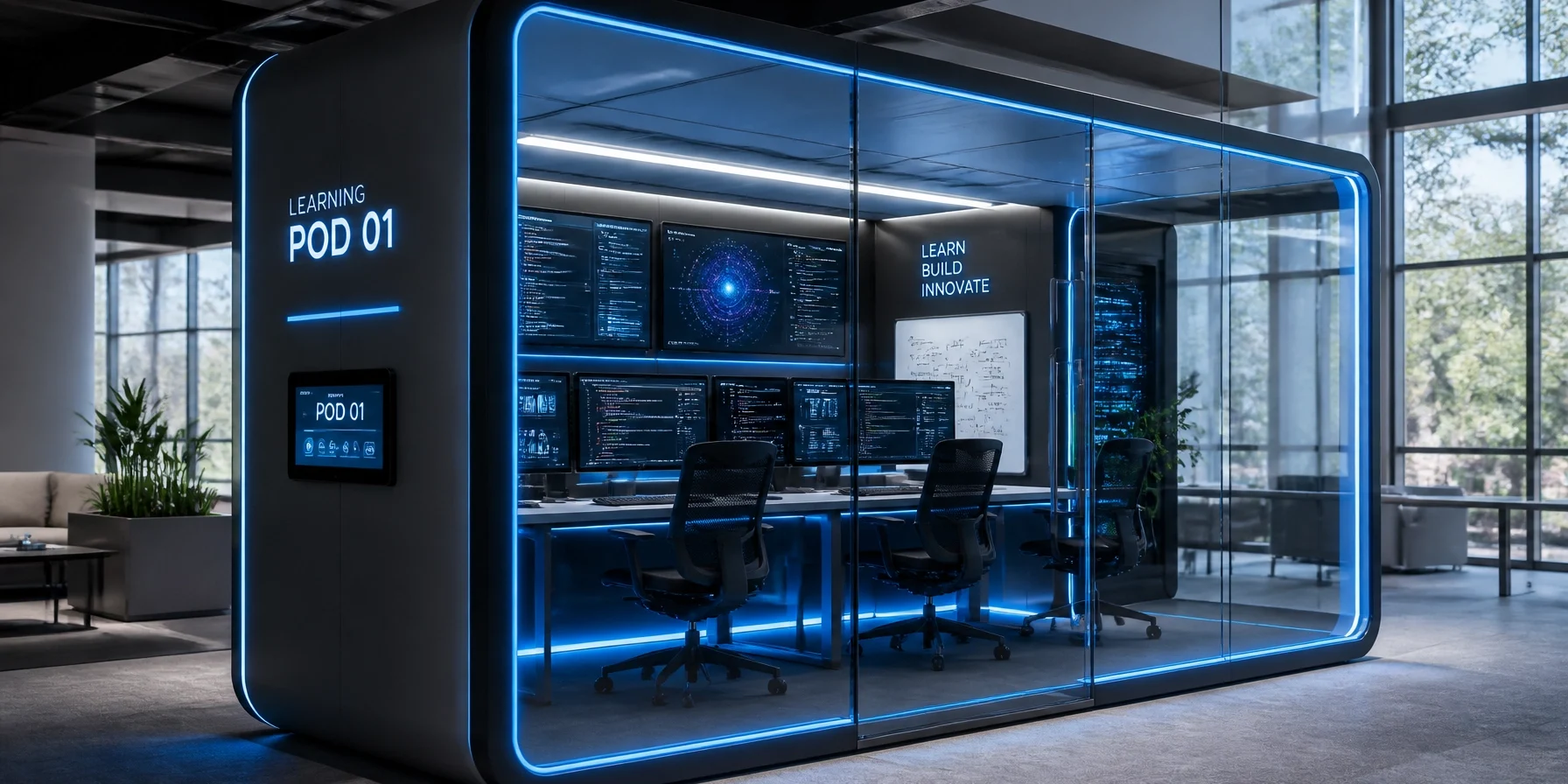
Traditional labs are "generalist" spaces. They try to do everything and, as a result, often do nothing at a professional grade. A modern Pod, by contrast, is a self-contained ecosystem. These modular units arrive as finished products, equipped with their own dedicated cooling, fiber-optic hardlines, and acoustic treatments. Research shows that universities adopting modular pods report roughly 30% lower infrastructure costs compared to traditional build-outs. Why? Because you aren't tearing down walls or rerouting HVAC systems every time you want to upgrade your tech. You just wheel the pod in, plug it in, and you’re in business.
This move from "rooms" to "nodes" allows organizations to create a distributed mesh network of high-tech gateways. Instead of making everyone trek to a single central lab, you put the tech exactly where the talent is.
Cybersecurity: The "Live-Fire" Sandbox
If you’re training the next generation of cybersecurity experts, you have a major problem: you can’t exactly let them practice "Red Team" attacks on your actual company network. One wrong move and you’ve accidentally deleted the payroll database or knocked the CEO’s Zoom call offline.

Traditional school and office networks are notoriously "porous," making them poor environments for realistic cyber training. This is where Pods shine. Because a Pod is physically and logically isolated from the main grid, it creates a perfect sandboxed environment.
Inside a Pod, students and trainees can engage in "live-fire" exercises. They can launch actual malware, simulate massive DDoS attacks, and practice defensive maneuvers in a controlled SOC (Security Operations Center) environment. It’s the difference between reading a book about flying and sitting in a high-fidelity flight simulator. As industry experts often note, the psychological shift of stepping into a dedicated "command center" pod reinforces the professional stakes of cybersecurity work. It stops being a homework assignment and starts being a career.
Content Creation: The New Literacy
We’ve all seen it: the "media center" that consists of a green bedsheet taped to a wall and a webcam that looks like it was salvaged from 2004. In 2026, content creation isn't just for influencers: it is the default language of professional communication. Whether you are a CEO delivering a virtual keynote, a consultant pitching a new strategy, or a doctor explaining a procedure, media literacy is non-negotiable.

Most traditional classrooms and offices are acoustic nightmares: all high ceilings and hard floors that make every video sound like it was recorded in a tiled bathroom. Pods solve this by acting as acoustic sanctuaries. With integrated lighting rigs, soundproofing, and professional-grade audio gear, Pods signal that the work being done inside has real value.
When a student or transitioning veteran enters a content creation pod, they aren't just "making a video." They are mastering the tools of modern persuasion. They are learning how to cut through the noise of a digital world, a skill that is as vital today as writing was a century ago.
Logistics: The Hidden Career Pathway
When people think of "infrastructure," they usually think of static things like bricks and mortar. But the shift toward Pods highlights a burgeoning career pathway that many overlook: Logistics and Modular Management.
The Pod model itself is a massive logistics puzzle. Managing a network of pods involves hardware lifecycle management, bandwidth allocation, and rapid deployment strategies. Students working in these environments get a front-row seat to how modern systems actually work. They see how modular components are swapped out and how physical space is optimized for different high-tech uses.

This experience maps directly to roles in global shipping, warehouse automation, and even urban planning. By moving away from the "static room" model, we are teaching people to think in terms of flow, scalability, and agility: the very pillars of the modern economy.
The Human Component: DOD SkillBridge and the Future Workforce
At USA Entertainment Ventures LLC, our focus is often on the most important piece of infrastructure of all: the people. Specifically, we look at how specialized infrastructure supports the transition of our military service members into civilian roles through the DOD SkillBridge program.
SkillBridge allows active-duty service members to spend their final 180 days of service in civilian internships and training programs. But to be effective, that training needs to happen in environments that mirror the high-stakes, high-tech reality of the private sector.

Using Pods as "technical training nodes" is a game-changer for SkillBridge. It allows us to create small, cohort-based "infrastructure pods" where veterans can dive deep into cybersecurity, cloud networking, or media production. These pods act as a bridge: taking the discipline and mission-focus of military service and applying it to the cutting-edge tech of the civilian world.
As Dan Kost, CEO of USA Entertainment Ventures LLC, often emphasizes, "Managing the transition is about providing the right tools in the right environment." By utilizing modular pods, we can provide a "front-door" recruiting pipeline that is as agile as the people it serves.
Conclusion: Investing in What Matters
Infrastructure isn't just about furniture and cables; it’s a statement of intent. When we cling to the dusty old computer labs of the past, we are implicitly telling the next generation of workers that we expect them to fit into old molds.
By embracing the Pod: modular, dense, isolated, and agile: we are preparing for a future that values specialization over generalism and results over square footage. Whether you are looking to bolster your cybersecurity posture, create world-class content, or streamline your DOD recruitment, remember: the environment you build today dictates the success you achieve tomorrow.
The beige towers are gone. The grey cables are being unplugged. It’s time to step into the Pod.